
Introduction to the Baglamukhi Mahamantra
In the vast ocean of Vedic knowledge, mantras serve as sacred vessels of divine energy. Among these, the Baglamukhi Mahamantra holds a unique place, revered by those who seek deep inner stillness and clarity. Maa Baglamukhi, the eighth Mahavidya, is known as the deity who governs the power of paralyses or stagnation of negative energy. The term ‘Mahamantra’ implies a fundamental vibration that resonates with the core of her divine presence.
For the sincere practitioner, this mantra is not merely a string of syllables but a bridge to understanding the nature of silence and truth. At Baglamukhi Guru, we approach this sacred sound with humility and respect, recognizing that the essence of such traditions lies in personal devotion and the cultivation of a sattvik lifestyle. This article explores the nature of the mantra, its symbolic depth, and how one might approach its significance within a traditional framework.
The Essence of the Mahamantra
The Baglamukhi Mahamantra is often associated with the concept of Stambhana, which in a spiritual context relates to the ability to pause, reflect, and stabilize one’s consciousness. When we chant or contemplate this mantra, we are invited to set aside the turbulence of the external world. It is a practice of anchoring the mind in the present moment, allowing for a deeper awareness to emerge.

Understanding the meaning of Maa Baglamukhi is essential for anyone who wishes to engage with her mantras. She represents the quiet power of the void—the space where all speech and action originate. By focusing on her, the practitioner seeks to align their own speech and actions with truth, ensuring that their efforts are grounded in clarity and purpose rather than impulsive reactions.
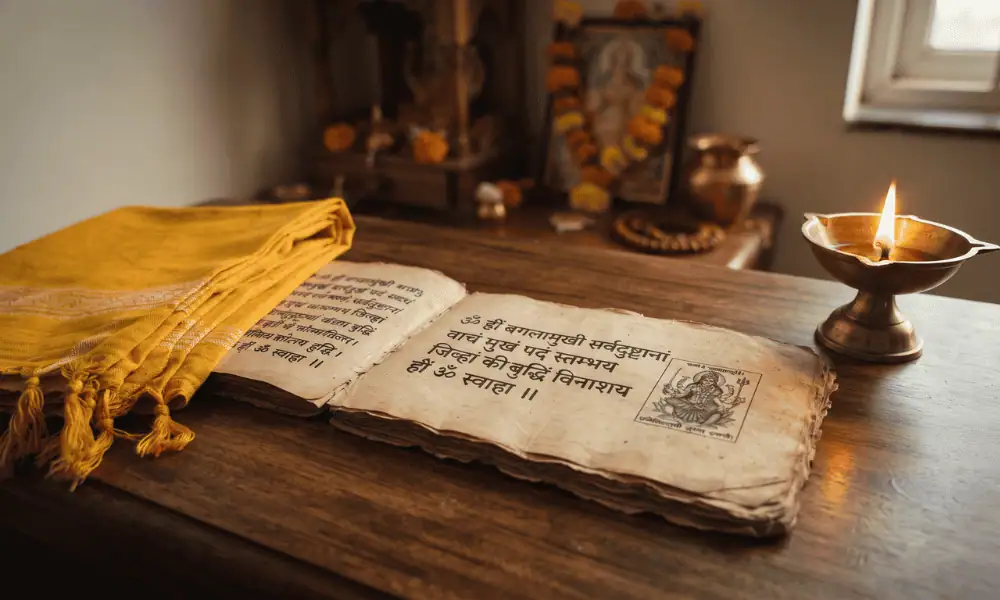
The Mahamantra acts as a resonance chamber for the soul. In traditional texts, the vibrations of these sacred sounds are said to align the practitioner’s subtle energetic body with the cosmic frequency of the Divine Mother. This is not about external domination or control, as some misconceptions might suggest, but about the internal mastery over the distractions that prevent one from perceiving reality as it truly is. By quieting the mental chatter, the practitioner clears a space where divine wisdom can naturally arise.
Devotional Approach and Practice
Traditional Vedic practice emphasizes that the power of a mantra is not found in the speed or frequency of its repetition, but in the quality of the practitioner’s intention. A devotional approach requires a disciplined heart and a consistent, sattvik routine. It is about creating a space for inner reflection, where the noise of daily life is quieted by the sound of the sacred syllables.
Many practitioners find it helpful to start their journey by understanding the traditional significance of the Baglamukhi mantra, including proper pronunciation and the meditative posture that supports focus. Practice is meant to be a steady, long-term commitment to self-growth and refinement of one’s character, rather than a method to manipulate external circumstances or achieve quick results. Authenticity in devotion is the hallmark of a sincere seeker.
When embarking on this practice, one should prioritize cleanliness, both physical and mental. A prepared altar, a quiet room, and a sincere heart serve as the foundation for effective meditation. The mantra should be chanted with an awareness of the breath, treating each syllable as a rhythmic pulse that brings the body and mind into equilibrium. By keeping the posture steady and the focus centered on the deity, the practitioner begins to experience a shift in their internal perspective, moving away from reactive patterns and toward a state of poised observation.
The Importance of Right Intention
In any spiritual path, the intention behind one’s actions determines the long-term impact on one’s life. Engaging with the Baglamukhi Mahamantra should be driven by a desire for inner transformation and clarity. When one approaches the Divine with an open heart, the focus shifts from the desire for specific outcomes to the appreciation of the connection itself.
We encourage our readers to view their practice as a form of meditation. Whether you are reciting the mantra or simply contemplating its meaning, let it be an act of gratitude and reverence. This perspective honors the traditions passed down through generations and protects the sanctity of the ritual. Remember that personal responsibility and practical action are never replaced by ritual; they work together in harmony to support a balanced and meaningful life.
The dangers of approaching sacred mantras with material greed or manipulative intentions are well-documented in Vedic literature. Such mindsets create an imbalance in the practitioner, leading to frustration rather than spiritual growth. Instead, true power is cultivated through surrender and the alignment of one’s will with the universal flow of truth. When the intent is purified, the mantra ceases to be a tool for personal gain and becomes a vehicle for liberation from the cycles of ignorance.
Integrating Vedic Wisdom into Daily Life
True spirituality is not limited to the time spent on the puja mat. It extends into every interaction, every decision, and every word we speak. The Mahamantra teaches us the power of pause, which we can apply in our daily lives by reflecting before we speak or act. By embodying the grace of Maa Baglamukhi, one learns to respond to the challenges of life with calm deliberation rather than frantic reaction.
For those seeking to explore deeper, our resources on the significance of the Baglamukhi Puja offer further guidance on how to integrate these ancient traditions into a modern, daily routine. Such practices are most effective when they are rooted in a genuine, lived philosophy of kindness, integrity, and disciplined self-awareness.
Consider how you interact with others. Are you speaking from a place of reaction, or from a place of thoughtful reflection? The Mahamantra serves as a reminder to maintain one’s center in the face of conflict. By developing this ‘internal pause,’ you are actually putting the principles of Stambhana into practice in real-world scenarios. This leads to better relationships, clearer professional judgments, and a profound sense of inner security that remains unshaken by external events.
The Symbolic Depth of Maa Baglamukhi
To fully grasp the Mahamantra, one must appreciate the symbolism of Maa Baglamukhi. She is often depicted holding a club, representing the power to strike down misconceptions and illusions. The yellow hue often associated with her practice symbolizes the brilliance of the sun and the purity of gold. Her form represents the truth that remains when all falsehoods are stripped away. As you engage with the mantra, visualizing these aspects can help deepen your concentration and strengthen your connection to the divine energy she represents.
This symbolism is not meant to be analyzed coldly, but to be absorbed meditatively. By holding these images in the mind, the practitioner fosters a state of receptive clarity. It is in this silence that the deeper layers of the Vedic tradition are revealed, providing insights that are often unavailable to the purely rational mind. Stay patient, stay humble, and let the process unfold at its own natural pace.
Conclusion
The Baglamukhi Mahamantra is a profound instrument for those on the path of self-discovery. By connecting with the energy of Maa Baglamukhi, we learn to cultivate stillness in the midst of movement and truth in the midst of deception. As you continue your journey, keep your heart open, your practice consistent, and your focus on the refinement of your own character. May your path be illuminated by wisdom and your spirit be guided by the enduring principles of the Vedic tradition.
Frequently Asked Questions
What is the primary significance of the Baglamukhi Mahamantra?
The primary significance lies in its role as a focal point for inner stillness and clarity. In Vedic tradition, it is used to cultivate the power of discernment, helping the practitioner pause and observe the truth beneath surface-level appearances.
Do I need a guru to begin practicing this mantra?
While the guidance of a qualified teacher or guru is traditionally considered ideal for any deep spiritual practice, one can certainly begin with respectful study and self-directed, humble devotion. Always approach the subject with a spirit of reverence and academic curiosity.
How long should I recite the mantra each day?
There is no fixed duration that guarantees a specific outcome. It is far more beneficial to chant for a shorter time with absolute focus, consistency, and a calm, sattvik mindset than to engage in long, distracted sessions. Quality of concentration is the most important factor.
Can the mantra solve my personal life problems?
Mantras are tools for spiritual development and mental clarity, not quick fixes for life’s challenges. They can help you gain the perspective and inner strength needed to face difficulties constructively, but they do not replace the need for practical action, medical care, or sound decision-making.
Is this mantra appropriate for everyone to chant?
The Baglamukhi Mahamantra is a powerful invocation intended for those who approach it with sincerity and a grounded, respectful heart. It is best suited for individuals who are genuinely interested in traditional Vedic practices and the development of their own inner consciousness.